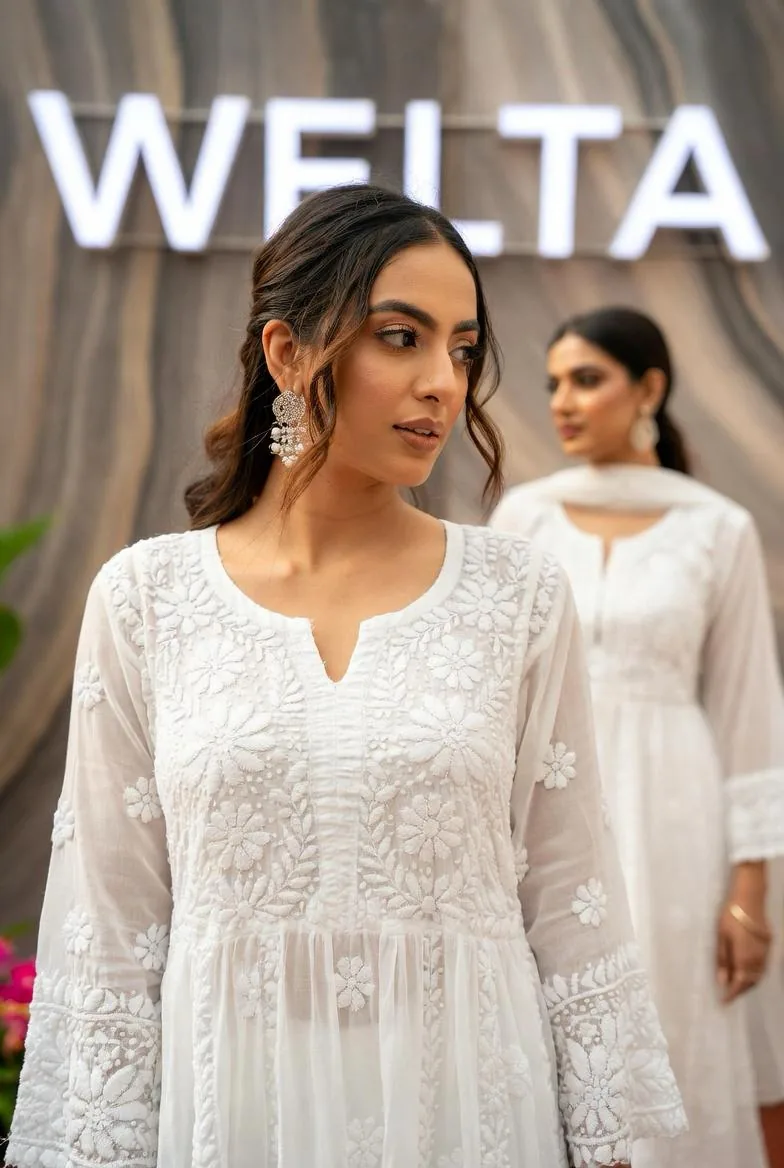
The History of Lucknow Chikankari
Updated July 2026
Chikankari is one of India's oldest surviving hand-embroidery traditions, and Lucknow remains its best-known home. Much of its early history is passed down through oral tradition rather than formal record, so historians describe its origins as likely rather than definitively dated.
Early origins
White-thread shadow embroidery techniques similar to chikankari are believed to have existed in India for centuries, with some accounts tracing threadwork traditions back over a thousand years.
Lucknow's specific chikankari tradition, as it's recognised today, is most closely associated with patronage during the era of the Nawabs of Awadh in the 18th and 19th centuries, when the craft flourished under courtly demand for fine, breathable embroidered muslin.
Why Lucknow specifically
The Nawabi court's taste for refined, understated luxury — favouring subtlety over heavy ornamentation — shaped chikankari into a craft defined by delicate white-on-white and tonal work, rather than bright, dense embroidery.
This is why classic chikankari is traditionally worked in white thread on white or pastel mulmul, a style that has remained central to the craft.
From court craft to livelihood craft
After royal patronage declined, chikankari survived because it became a livelihood craft practiced widely across Lucknow and surrounding areas, passed down through families and artisan communities rather than confined to court workshops.
Lucknow was granted a Geographical Indication (GI) tag for chikankari embroidery, formally recognising it as a craft specific to the region.
Chikankari today
Modern chikankari has expanded beyond white-on-white to include coloured threads, mixed techniques, and contemporary silhouettes — while the core hand stitches (jaali, bakhiya, mukesh, and others) remain unchanged from generations past.
Every Welta piece is made in our Lucknow atelier, continuing that same hand-embroidery tradition.
Shop related pieces